

Introduction
An asbestos test kit can be useful when homeowners, property managers, contractors, or building professionals need to determine whether a material may contain asbestos. Asbestos was widely used in construction because it is resistant to heat, fire, and chemical damage. Older buildings may contain asbestos in insulation, floor tiles, roofing materials, textured coatings, cement products, pipe coverings, and other construction components. The presence of asbestos does not automatically mean that a building is dangerous. The greater concern occurs when asbestos-containing materials are damaged, disturbed, cut, drilled, sanded, or otherwise released into the air.
An asbestos test kit generally provides a way to collect a material sample for laboratory examination. However, the kit itself does not necessarily identify asbestos simply through a visual inspection. Laboratory analysis using appropriate methods is normally needed for reliable identification. Because disturbing suspected asbestos can release hazardous fibers, sampling should be approached cautiously and, where required or appropriate, performed by a trained professional. Understanding what a test kit can and cannot do helps people make safer decisions about renovation, maintenance, demolition, and property management.
What Is an Asbestos Test Kit?
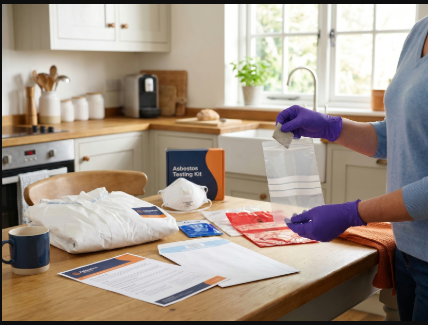
An asbestos test kit is a testing or sampling package designed to help obtain a specimen from a material that could contain asbestos. Depending on the provider, a kit may include sample bags, labels, instructions, protective equipment, forms, and materials for sending a specimen to a laboratory. Some kits are designed specifically for laboratory submission rather than providing an immediate result at the property.
The important point is that asbestos cannot reliably be confirmed simply by looking at a material. Materials that appear similar may have completely different compositions. A professional laboratory can examine a properly collected sample using recognized analytical techniques. Therefore, the quality of the sample and the competence of the laboratory are important parts of the overall testing process.
Why Is Asbestos Testing Important?
Asbestos fibers are microscopic and can become airborne when asbestos-containing materials are disturbed. People who inhale asbestos fibers over time can face serious health risks. The potential risk depends on factors such as the type and amount of asbestos, the condition of the material, the extent of disturbance, and the duration and frequency of exposure.
Testing can therefore help determine whether a suspected material needs further assessment before renovation or maintenance work begins. For example, an older floor tile, insulation product, ceiling coating, or cement sheet may look ordinary while containing asbestos. Knowing the material’s composition can help property owners and contractors plan appropriate controls.
Testing is particularly relevant before activities that could disturb older building materials. Rather than assuming that an unfamiliar material is asbestos-free, obtaining reliable information can support safer project planning.
Where Might Asbestos Be Found?
Asbestos was incorporated into numerous products, particularly in older construction. Potential locations include insulation around pipes and boilers, roofing materials, siding, cement products, floor tiles, adhesives, ceiling materials, textured coatings, and some fire-resistant products.
The appearance of a material alone is not enough to establish whether asbestos is present. Age, building history, renovation records, product information, and professional inspection can provide useful context. However, these factors still may not replace laboratory analysis when confirmation is necessary.
A building may also contain several different materials with different compositions. Testing one product does not automatically establish the composition of every other material in the property. A broader inspection may therefore be appropriate when extensive renovation or demolition is planned.
How Does an Asbestos Test Kit Work?
The exact procedure varies by product and jurisdiction, but an asbestos test kit commonly involves collecting a small sample and submitting it to an appropriate laboratory. The sample must be clearly identified and handled according to the instructions supplied with the testing service.
Sample collection is the most sensitive part of the process because disturbing a suspected asbestos-containing material can potentially release fibers. Cutting, breaking, drilling, scraping, sanding, or aggressively handling the material can increase the possibility of exposure.
For this reason, people should carefully consider whether they are qualified and permitted to collect the sample themselves. In many situations, using a qualified asbestos professional is a safer approach. Local regulations may also specify who can collect, transport, or analyze asbestos samples.
Can You Identify Asbestos at Home?

An asbestos test kit should not be treated as a simple visual identification tool. Asbestos fibers cannot be reliably identified by ordinary eyesight, and photographs are generally insufficient for confirming asbestos content.
Some consumer-oriented testing services make sample collection convenient, but the meaningful result comes from laboratory analysis. A laboratory may use specialized microscopy or other recognized analytical procedures to determine whether asbestos is present and, where applicable, identify its type or concentration.
If a suspected material is damaged or deteriorating, it may be better to avoid disturbing it while arranging professional advice. The objective should be to obtain useful information without unnecessarily increasing the potential for fiber release.
Safety Precautions During Sampling
Safety should be the first consideration whenever suspected asbestos-containing material is involved. Avoid unnecessary disturbance of the material, particularly activities that create dust. Do not dry-sand, drill, saw, grind, or break suspected materials simply to obtain a sample.
If professional sampling is required, trained personnel can assess the material and use appropriate controls. Depending on the situation, precautions may include controlled work practices, suitable personal protective equipment, containment measures, and proper waste handling.
A test kit does not eliminate the hazards associated with asbestos. It is simply a tool within a larger testing process. Following the manufacturer’s instructions and applicable local requirements is important, especially when samples need to be transported to a laboratory.
Choosing a Reliable Testing Service
When selecting an asbestos test kit, consider what the package actually provides. Some products may provide only sampling materials, while others include laboratory analysis. Understanding the difference can prevent confusion about what the purchase includes.
Look for clear information about the laboratory performing the analysis, the analytical method used, sample requirements, reporting procedures, and expected turnaround time. Where regulations require accreditation or specific qualifications, verify that the laboratory and sampling professional meet those requirements.
A useful report should clearly identify the sample and communicate the laboratory’s findings. If the result is unclear or the sample may not represent the material of concern, additional professional assessment may be necessary.
What Happens After Testing?
The next step depends on the laboratory result and the condition of the material. If asbestos is not detected, the result may help with project planning, although one sample cannot necessarily represent every material throughout a building.
If asbestos is identified, the material does not automatically need to be removed. In some circumstances, asbestos-containing materials can remain in place when they are intact and appropriately managed. Removal, encapsulation, enclosure, or other management approaches depend on the material, condition, location, planned work, and applicable regulations.
Professional advice can help determine the appropriate response. Any planned renovation or demolition that could disturb confirmed asbestos should be carefully assessed before work begins.
Common Mistakes to Avoid
One common mistake is assuming that a material is safe because it looks modern or undamaged. Another is assuming that every older material contains asbestos. Neither assumption provides reliable confirmation.
Another problem is collecting a sample without considering the potential for fiber release. Taking a larger sample than necessary, breaking materials unnecessarily, or creating dust can increase risk. People may also misunderstand a laboratory result and assume that testing one material proves that an entire property is asbestos-free.
An asbestos test kit should therefore be viewed as part of a controlled identification process rather than a substitute for professional assessment. When significant renovation, demolition, or damaged materials are involved, qualified asbestos professionals may provide more appropriate guidance.
Asbestos Testing Before Renovation
Renovation is one of the situations in which asbestos identification can become particularly important. Activities such as removing flooring, opening walls, replacing insulation, repairing ceilings, or modifying older roofing materials may disturb hidden products.
Before beginning work in an older property, it can be useful to establish what materials are present and whether any require special handling. Testing suspected materials before disturbance can help contractors and property owners plan the work appropriately.
The precise requirements vary by location and project type. Building owners should follow applicable occupational health, environmental, and waste-management requirements rather than relying solely on general online advice.
Understanding Laboratory Results
Laboratory results should be read carefully. A positive result indicates that asbestos was detected in the submitted sample, while a negative result generally applies only to the sample analyzed. The result does not necessarily establish the composition of visually similar materials elsewhere.
The report may also provide information about asbestos type or percentage, depending on the testing method and laboratory. If the result is being used to make decisions about renovation, demolition, or occupational exposure, professional interpretation may be valuable.
Keeping laboratory reports with property maintenance records can also help future owners, contractors, and building managers understand what has already been tested.
Frequently Asked Questions
Is an asbestos test kit accurate?
Accuracy depends on proper sampling, representative material selection, and competent laboratory analysis. The kit itself does not guarantee an accurate result. If sampling is performed incorrectly or the specimen does not represent the material of concern, the result may not provide a complete picture.
Can I test asbestos without disturbing the material?
Laboratory confirmation generally requires a representative sample, but disturbing suspected asbestos can create exposure concerns. If sampling could damage the material or release dust, professional assessment is advisable.
Does every old building contain asbestos?
No. Older buildings may contain asbestos-containing materials, but age alone does not prove that asbestos is present. Building records, material history, inspection, and laboratory testing can provide more reliable information.
What should I do if asbestos is found?
Do not automatically disturb or remove the material. Its condition, location, and intended work should be assessed. Qualified asbestos professionals can help determine appropriate management or removal procedures under applicable regulations.
Is one test enough for an entire building?
Not necessarily. Different materials and areas can have different compositions. A testing plan should reflect the scope of the property and the planned work.
Conclusion
An asbestos test kit can provide a practical route to laboratory testing when asbestos may be present in an older building material. However, the kit is only one component of a safe testing process. Reliable identification depends on appropriate sampling, competent laboratory analysis, accurate documentation, and careful interpretation of the results.
Because disturbing suspected asbestos can create exposure risks, unnecessary sampling or DIY disturbance should be avoided. For renovation, demolition, damaged materials, or situations involving significant uncertainty, qualified professionals can provide appropriate assessment and control measures. Used correctly, asbestos testing can provide valuable information for making informed decisions about building maintenance and renovation while reducing unnecessary exposure risks.