

Introduction
Asbestos is a naturally occurring group of minerals that was widely used in construction, insulation, manufacturing, and other industries because of its strength, heat resistance, and insulating properties. Although it was once considered a valuable building material, asbestos is now recognized as a serious health hazard when its microscopic fibers become airborne and are inhaled. Understanding its appearance can help homeowners, workers, property managers, and renovators recognize materials that may require professional assessment.
One of the most important things to understand when asking what does asbestos look like is that it does not have one specific color, shape, or texture. Depending on its mineral type and the product in which it was used, asbestos-containing materials may appear white, gray, brown, greenish, or blue. Some products have a fibrous appearance, while others look like ordinary cement sheets, floor tiles, insulation, or textured coatings. Consequently, visual inspection alone cannot reliably confirm whether a material contains asbestos.
What Is Asbestos?
Asbestos refers to six naturally occurring silicate minerals known for forming thin, durable fibers. These fibers can resist heat, friction, and many chemical processes, making asbestos useful in numerous commercial and industrial applications. Historically, manufacturers incorporated it into insulation, roofing products, cement materials, pipe coverings, brake components, and fire-resistant products.
The main concern with asbestos is its microscopic structure. When asbestos-containing materials are damaged, cut, drilled, sanded, or disturbed, tiny fibers may enter the air. People can inhale these fibers without noticing them because they are generally too small to see individually. Exposure can lead to serious illnesses, including asbestosis, lung cancer, and mesothelioma. These diseases may take many years to develop after exposure.
Although many countries have restricted or prohibited particular asbestos uses, older buildings and industrial facilities may still contain asbestos-containing materials. Recognizing potentially hazardous materials and avoiding unnecessary disturbance are important steps in protecting occupants and workers.
What Does Asbestos Look Like in Its Natural Form?
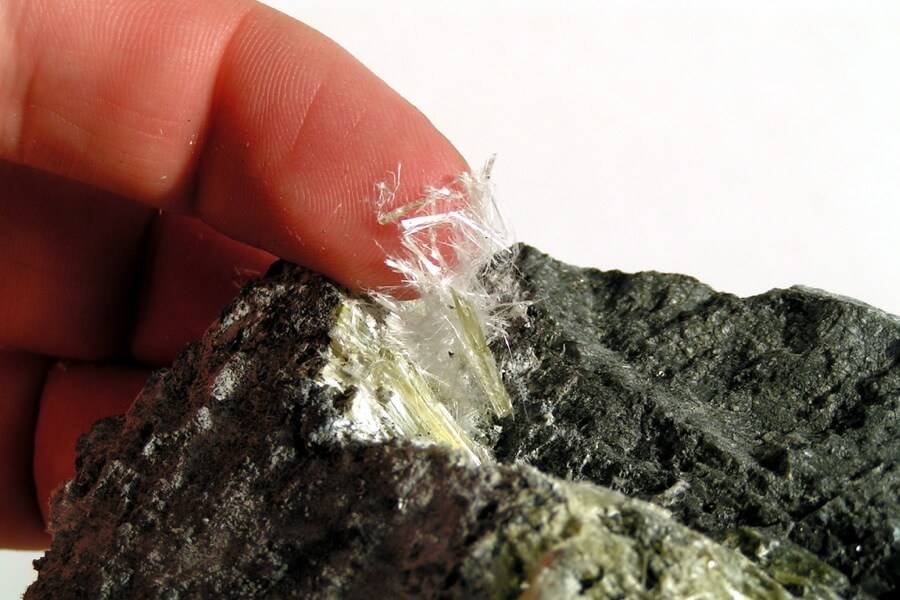
In its natural form, asbestos is generally found in mineral deposits within rocks. Depending on the mineral type and surrounding geological material, it may appear as bundles of fine fibers, silky strands, fibrous veins, or elongated mineral formations. Some samples have a soft, hair-like appearance, while others look more compact or resemble thin threads embedded in rock.
Chrysotile, commonly known as white asbestos, often has curly or wavy fibers. Amphibole asbestos minerals, including crocidolite and amosite, can form straighter, more rigid fibers. However, these characteristics are not dependable enough to identify asbestos without mineralogical testing.
Natural asbestos deposits may occur alongside other minerals that have similar colors and textures. A rock containing white, green, gray, or blue fibers is not automatically asbestos. Likewise, asbestos may be present in processed materials without any visible fibers. Professional laboratory analysis is necessary to establish whether a sample contains asbestos.
Common Colors of Asbestos
Asbestos is associated with several colors, but its appearance varies according to the mineral species, manufacturing process, and condition of the material.
White Asbestos
Chrysotile is the type historically used most widely in commercial products. Its natural fibers may look white, pale gray, or greenish. In manufactured products, chrysotile may be incorporated into cement sheets, insulation, textured coatings, and other building materials. Once mixed with cement or other substances, the asbestos fibers may not be visible.
Brown Asbestos
Amosite, often called brown asbestos, can have grayish-brown, tan, or golden-brown tones in its mineral form. Historically, it was used in some insulation boards, thermal insulation products, and other construction materials. Its color alone cannot establish whether a product contains amosite.
Blue Asbestos
Crocidolite is commonly known as blue asbestos because natural samples can have blue or blue-gray hues. It was used in certain industrial applications, including some insulation and cement products. Like other asbestos types, it may be difficult or impossible to recognize in a finished product.
Other asbestos minerals can have greenish, gray, or mixed colors. Therefore, color should be treated only as a descriptive characteristic rather than a reliable identification method.
What Does Asbestos Look Like in Homes?
Asbestos may be present in older residential buildings in materials that appear completely ordinary. Its appearance depends largely on how the material was manufactured and installed. For example, asbestos-containing cement sheets may resemble standard fiber-cement boards, while some older floor tiles have a smooth, uniform surface.
Potential locations include pipe insulation, boiler insulation, roofing sheets, wall panels, ceiling tiles, textured coatings, vinyl floor tiles, and certain adhesives. Some older insulation products may look fluffy or fibrous, whereas asbestos cement products generally appear hard and solid.
It is important to remember that not every old building material contains asbestos. Many products that resemble asbestos-containing materials were manufactured without it, and some asbestos-containing products do not have any distinctive visual clues. The building’s age, renovation history, product documentation, and laboratory findings provide more useful information than appearance alone.
If you suspect a material contains asbestos, do not scrape it, break it, drill into it, or remove a sample yourself. An undamaged material that is left undisturbed may pose less immediate risk than one that releases fibers into the air.
What Does Asbestos Insulation Look Like?
Asbestos insulation appeared in several forms throughout older residential, commercial, and industrial buildings. Some types were applied around hot-water pipes, boilers, heating equipment, and industrial machinery. These materials may resemble thick white or gray coverings, rigid insulating boards, paper-like wraps, or hardened coatings.
Certain older pipe insulation products have a chalky or plaster-like exterior. Others may have a woven covering, a fabric-like appearance, or visible layers around a pipe. Some sprayed insulation materials have a rough, uneven texture and may resemble foam or a fibrous coating.
However, these characteristics are not exclusive to asbestos. Modern insulation materials can look similar, and asbestos fibers may be concealed beneath paint, fabric, cement, or other protective layers. Never pull back a covering or cut into insulation to investigate its contents.
When insulation is damaged, crumbling, or deteriorating, avoid the area if doing so is practical and arrange an assessment by a qualified asbestos professional. Specialized sampling and laboratory analysis can determine whether asbestos is present and whether further precautions are needed.
What Does Asbestos Look Like in Roofing and Cement Sheets?
Asbestos-containing cement products were widely used because they combined durability with resistance to weather and fire. In older buildings, these products may include corrugated roofing sheets, flat panels, exterior cladding, wall boards, and certain water or drainage pipes.
Such products usually look like hard, gray or pale-colored cement. Corrugated roofing sheets have repeating ridges, while flat panels may resemble conventional cement boards. Their surfaces may be smooth, weathered, painted, stained, or covered with moss and dirt after years of outdoor exposure.
A significant challenge is that asbestos cement does not necessarily display visible fibers. The asbestos may be bound within the cement matrix, making the finished product look similar to non-asbestos cement. The absence of visible fibers does not mean that a product is asbestos-free.
Older cement roofing and panels should not be drilled, cut, broken, or power-washed until their composition has been assessed where asbestos is suspected. Damaging these products can release hazardous fibers. Local regulations may also specify how asbestos-containing construction materials must be inspected, handled, transported, and disposed of.
What Does Asbestos Look Like in Floor Tiles and Interior Finishes?
Some older vinyl floor tiles, sheet flooring, flooring backings, and adhesives contained asbestos. These materials may look like ordinary decorative flooring, with plain colors, marbled patterns, speckles, or geometric designs. Some tiles have a hard, smooth surface, while older backing materials may appear fibrous or paper-like.
Asbestos-containing floor tiles cannot be reliably identified by their dimensions, color, pattern, or general appearance. Similar products were made using other ingredients, and the original flooring may have been covered with newer materials over time.
Certain older wall and ceiling finishes also deserve attention. Textured coatings, decorative finishes, and some ceiling panels may have contained asbestos depending on the product and period of installation. A rough or popcorn-like texture does not, by itself, establish the presence of asbestos.
If old flooring or decorative finishes are suspected to contain asbestos, avoid sanding, scraping, breaking, or using power tools on them. Professional evaluation is especially important before renovation, demolition, or replacement work begins.
Can You Identify Asbestos by Looking at It?
Visual inspection can help identify materials that deserve further investigation, but it cannot confirm asbestos content. The reason is that asbestos is frequently mixed with cement, resin, paper, adhesives, insulation compounds, and other materials during manufacturing. These mixtures can conceal the mineral fibers completely.
Even trained inspectors generally cannot confirm asbestos solely by looking at a suspect material. They consider the building’s age, product type, installation location, condition, and available records. When confirmation is required, a properly collected sample is analyzed by a qualified laboratory using suitable analytical methods.
A suspected material should not be sampled casually. Collecting a sample can release fibers if it is performed incorrectly. A trained asbestos professional can determine whether sampling is necessary, follow appropriate safety procedures, and arrange laboratory testing.
When considering what does asbestos look like, the safest conclusion is that appearance provides clues, not proof. If the material is intact and does not need to be disturbed, leaving it alone while seeking professional advice may be the most appropriate first step.
Where Is Asbestos Commonly Found?
Asbestos-containing materials have been used in a wide range of products, especially in older buildings and industrial facilities. Their presence depends on the product’s manufacturing date, country of origin, local regulations, and renovation history.
Common locations and products that may warrant assessment include:
-
Pipe and boiler insulation: Older thermal insulation around heating equipment and industrial pipes.
-
Roofing and exterior panels: Certain corrugated cement sheets, cladding boards, and building panels.
-
Flooring products: Some older vinyl tiles, backing materials, and flooring adhesives.
-
Ceilings and walls: Certain textured coatings, boards, and ceiling materials.
-
Fire-resistant products: Selected older insulation boards, gaskets, and industrial components.
-
Older utility products: Certain cement pipes and other manufactured construction materials.
This list is not a confirmation that any particular product contains asbestos. Similar materials may be asbestos-free, and products containing asbestos may not show any obvious visual differences. Professional assessment is especially valuable before work that could disturb older building materials.
Health Risks Associated With Asbestos
The primary health risk occurs when airborne asbestos fibers are inhaled. These fibers can penetrate deep into the respiratory system, and some may remain in the body for long periods. Depending on the exposure circumstances, asbestos exposure can cause asbestosis, lung cancer, and mesothelioma, a cancer affecting the lining of the lungs or other internal surfaces.
Risk depends on several factors, including the amount of airborne asbestos, the duration and frequency of exposure, the type of fibers, and individual circumstances. Smoking significantly increases the risk of lung cancer among people exposed to asbestos.
Not every encounter with a suspected asbestos-containing product results in significant exposure. An intact material that remains undisturbed generally presents less immediate risk of releasing fibers than a damaged or actively disturbed material. Nevertheless, there is no need to create unnecessary exposure by touching, breaking, or testing a suspected product without appropriate precautions.
If you believe you have been exposed, a healthcare professional can help assess the circumstances and advise whether follow-up is appropriate. Seek medical advice for health concerns rather than relying on the appearance of the material to estimate exposure.
What Should You Do If You Suspect Asbestos?
If you discover a material that may contain asbestos, the first step is to avoid disturbing it. Do not cut, drill, sand, scrape, sweep, or break the material. Avoid using an ordinary household vacuum cleaner on suspected asbestos debris because it may spread fibers through the air.
If the material is intact, keep people away from it when practical and arrange an assessment before renovation or maintenance work. If the material is damaged or debris is present, avoid the affected area and seek advice from a qualified asbestos professional. Do not attempt to clean it up yourself.
Professional inspectors can assess the condition of the material and determine whether sampling or other action is appropriate. Depending on the situation, the best solution may be monitoring an intact material, sealing or enclosing it through an approved method, or arranging professional removal. Removal is not always necessary, and disturbing an otherwise stable material can increase the risk.
Requirements vary by location, so follow applicable local safety and waste-disposal regulations. In workplaces, building owners and employers may have specific responsibilities for asbestos assessment and worker protection.
Conclusion
Understanding what does asbestos look like can help people recognize potentially hazardous materials in older homes, commercial buildings, and industrial facilities. Asbestos may occur naturally as fine mineral fibers or be incorporated into products such as insulation, cement roofing sheets, floor tiles, and textured finishes. Its color may range from white and gray to brown, greenish, or blue, depending on the mineral and the product.
However, asbestos does not have a single recognizable appearance. Many asbestos-containing products look like ordinary building materials, while similar-looking products may contain no asbestos at all. Visual clues cannot provide a definitive answer, and damaging a suspected material to inspect it can create unnecessary exposure.
The safest approach is to avoid disturbing questionable materials, seek qualified professional advice, and use appropriate laboratory testing when confirmation is necessary. Awareness, careful handling, and informed decisions can help protect building occupants, maintenance workers, and renovation teams from avoidable asbestos exposure.