

Introduction
Asbestos is a naturally occurring mineral that was widely used in construction, manufacturing, insulation, and other industries because of its heat resistance, strength, and durability. Although it was once considered a useful building material, it is now recognized as a serious health hazard when its microscopic fibres become airborne and are inhaled. Many older buildings, homes, industrial facilities, and commercial structures may still contain asbestos-based products, making awareness and safe handling extremely important.
People often search for what does asbestos look like when they discover an unusual material in their ceiling, wall, roof, pipe insulation, flooring, or other building components. The material may appear grey, white, brown, or even blue, depending on the asbestos type and the product in which it was used. However, asbestos cannot be reliably identified simply by its appearance. Materials that look similar may contain completely different substances, and laboratory testing is necessary to confirm whether asbestos is present.
Understanding the common appearances of asbestos can help people recognize potentially hazardous materials and avoid accidental exposure. The most important thing is not to touch, scrape, break, drill, or disturb suspicious materials. Learning about asbestos appearance is useful for awareness, but professional inspection and testing are the safest ways to determine what a material contains.
1. Understanding What Asbestos Is
Asbestos refers to a group of naturally occurring minerals that form long, thin, strong fibres. These minerals were widely used during the twentieth century because they could withstand high temperatures, resist fire, provide insulation, and strengthen various products. Asbestos was incorporated into numerous building materials, industrial equipment, automotive products, and household items.
There are several types of asbestos minerals, including chrysotile, amosite, crocidolite, tremolite, actinolite, and anthophyllite. Chrysotile is commonly known as white asbestos, amosite as brown asbestos, and crocidolite as blue asbestos. Their mineral structures and fibre characteristics differ, but all asbestos types can pose serious health risks when their fibres are inhaled.
Asbestos fibres are extremely small and cannot normally be seen individually with the naked eye. In building materials, they are often mixed with cement, plaster, adhesives, insulation, or other substances. As a result, the finished material may look like an ordinary construction product rather than a fibrous mineral. Some asbestos materials are hard and solid, while others are soft, fluffy, powdery, or easily damaged.
This explains why people cannot confidently identify asbestos by simply examining a material. Understanding its possible forms is helpful, but visual recognition should never replace professional assessment.
2. What Does Asbestos Look Like in General?
When asbestos is present in its loose mineral form, it may look like a collection of thin, hair-like fibres that form bundles or wispy strands. Some samples have a soft, fluffy appearance, while others look compact, layered, or fibrous. Depending on the mineral type, the fibres may appear white, grey, brown, blue, or greenish.
However, asbestos used in construction usually does not look like loose fibres. It may be hidden inside a solid sheet, cement panel, floor tile, insulation board, roofing product, pipe covering, or textured surface. The appearance depends largely on the other materials mixed with asbestos and the manufacturing process used to create the product.
For example, asbestos cement roofing can look like ordinary grey cement sheets. Older floor tiles may look like conventional vinyl tiles, and insulation boards may resemble plasterboard or other building panels. Pipe insulation might be covered with fabric, paint, or protective coatings that completely conceal its original appearance.
Therefore, when someone asks what does asbestos look like, the answer is that it has no single recognizable appearance. It may look like a common building material, a rough fibrous coating, a solid cement sheet, a fluffy insulation product, or a mineral-like substance.
3. Common Colours of Asbestos
Colour can offer clues, but it cannot confirm asbestos.
Asbestos-containing materials may have several colours depending on the mineral type, manufacturing process, age, and protective coatings. Some materials are naturally pale, while others may appear dark or coloured because of cement, paint, dirt, or other substances.
White asbestos
Chrysotile, also known as white asbestos, is one of the most widely used asbestos types historically. Its fibres are generally soft, flexible, and curved. When incorporated into construction products, it may be found in cement sheets, insulation, textiles, and other materials.
Brown asbestos
Amosite asbestos is commonly associated with brown or grey-brown fibres. It was historically used in insulation products, insulating boards, and other materials that required heat resistance.
Blue asbestos
Crocidolite is often called blue asbestos. Its fibres are associated with a blue-grey appearance in some mineral samples, although the colour may not be obvious when it is mixed with other materials.
Other asbestos minerals may look greenish, grey, white, or similar to surrounding rocks and materials. The names white, brown, and blue asbestos describe mineral types and do not mean that every asbestos-containing product will display those colours.
4. What Does Asbestos Look Like in Roofing Materials?
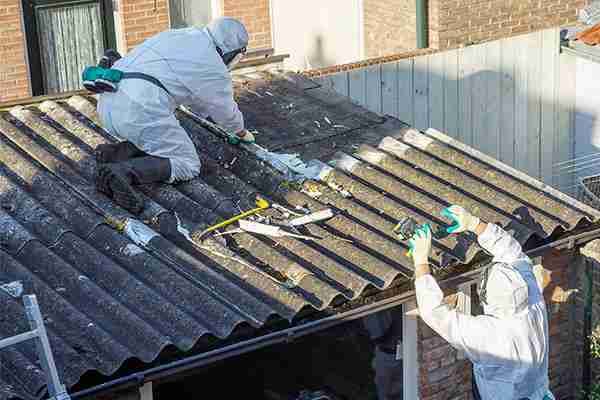
Asbestos was historically used in roofing because it provided strength, durability, weather resistance, and protection against fire. Asbestos cement roofing products were manufactured into corrugated sheets, flat panels, and other shapes for buildings, garages, warehouses, sheds, and industrial structures.
These roofing materials often look grey, rigid, cement-like, and textured. Corrugated sheets have repeating raised ridges and grooves that help manage rainwater. Older sheets may appear weathered, faded, stained, moss-covered, or rough along their edges. Some roofing materials may have been painted, making their original colour difficult to recognize.
Aged asbestos cement sheets may develop cracks, surface deterioration, chipped edges, or damaged areas. However, ordinary cement products can show similar signs of ageing, so the appearance alone is not proof of asbestos.
If an old roof contains suspicious cement sheets, avoid cutting, drilling, sanding, breaking, or pressure-washing them. Such activities can damage the material and potentially release hazardous fibres. Inspection and maintenance should be handled by people qualified to assess asbestos risks.
Older heating systems, boilers, industrial equipment, and pipe networks sometimes used asbestos-containing insulation to reduce heat loss and protect surrounding surfaces. Pipe insulation may appear very different from roofing materials because it was designed to wrap around pipes, valves, and other equipment.
It may look like a thick white, grey, or beige covering around pipes. Some insulation has a rough, fibrous, chalky, or layered texture. Other materials may have a smooth exterior because they were covered with fabric, paper, metal, paint, or a protective coating.
Damaged pipe insulation may show exposed fibres, loose fragments, crumbling edges, or powdery material. In some cases, old insulation can be found in patches around boilers, behind equipment, inside service areas, or along walls.
The appearance of pipe insulation is particularly important because some asbestos insulation products can release fibres very easily when damaged. If you discover deteriorating material around old pipes, do not attempt to remove it or clean up the fragments yourself. Keep people away from the affected area and arrange an appropriate professional inspection.
6. What Does Asbestos Look Like in Ceiling Tiles and Boards?
Asbestos-containing boards and ceiling products were historically used for fire protection, insulation, sound reduction, and general building construction. Some materials were installed in ceilings, partitions, bulkheads, fire doors, window surrounds, and other areas.
These products may look like ordinary rectangular panels, flat boards, ceiling tiles, or wall sheets. Their surfaces may be smooth, textured, painted, patterned, or slightly rough. Some boards are white or light grey, while others appear beige or brown.
Asbestos insulating boards may resemble other types of building board, meaning a person cannot determine their contents by sight alone. Older ceiling panels may have square or rectangular shapes with decorative patterns or small surface textures. Some panels may be hidden behind newer ceilings or other renovations.
When such materials are cracked, damaged, or exposed during renovation, the potential for fibre release can increase. It is particularly important to avoid breaking ceiling panels, removing old boards, or cutting through suspicious building materials without a suitable assessment.
7. What Does Asbestos Look Like in Floor Tiles?
Asbestos was historically incorporated into certain vinyl, PVC, thermoplastic, and other floor-covering products. It was used to improve durability, strength, and resistance to wear.
Older asbestos-containing floor tiles may look like ordinary decorative tiles. They may have square shapes, smooth surfaces, solid colours, speckled patterns, or marbled designs. Depending on their age and design, they might appear black, brown, cream, grey, white, or other colours.
Some old flooring materials may be located underneath newer carpets, laminate flooring, or replacement tiles. Adhesives used to attach older floor coverings may also potentially contain asbestos.
People often notice these materials while replacing floors, removing carpets, or renovating older homes. Even when the tiles look solid, attempting to scrape, sand, break, or mechanically remove them can create unnecessary exposure risks. A qualified professional can assess the flooring and determine whether testing or specialized handling is needed.
Loose-fill asbestos insulation is among the forms that require particular caution. Unlike asbestos cement sheets or solid floor tiles, loose insulation may consist of fluffy, soft, lightweight material that resembles cotton, wool, or candyfloss.
It may be white, pale grey, blue-grey, or another shade. It can be found in some cavities, roof spaces, beneath floors, or in other hidden building locations. Its loose texture means it can be disturbed easily by movement, airflow, maintenance work, or renovation activities.
Loose-fill insulation should never be handled casually. Its appearance can be similar to other types of insulation, but suspected loose asbestos must be treated as potentially hazardous until professionally assessed.
If you encounter fluffy insulation in an older building, avoid entering the affected area, moving the material, sweeping it, or using a household vacuum. Keep other people away and seek professional assistance.
Asbestos was also manufactured into heat-resistant textile products. These materials were used in certain industrial settings, heating equipment, ovens, electrical systems, and machinery where protection against heat was required.
Asbestos-containing rope may look like a thick, woven, twisted, or braided cord. It may be white, grey, tan, or darkened by age and use. Insulation tape can resemble fabric strips, while old gaskets may appear like flat rings, compressed sheets, or dark sealing components.
These products are not always obviously fibrous from the outside. A gasket or rope may have a smooth or compressed appearance, especially when it has been used for a long time. Older equipment may also contain asbestos components hidden behind covers or inside enclosed compartments.
If you discover unusual rope, sealing material, or insulation inside an older appliance or industrial system, do not dismantle the equipment to investigate. Avoid scraping or pulling the material, as disturbing it may release fibres.
The condition of a suspected material is an important consideration. Asbestos-containing materials that remain intact and undisturbed may present a different exposure risk from materials that are damaged, deteriorating, or easily crumbled.
Possible visible signs of deterioration include:
-
Cracked or broken edges.
-
Flaking, peeling, or crumbling surfaces.
-
Exposed fibrous areas.
-
Loose fragments around a material.
-
Powdery deposits beneath damaged insulation.
-
Water damage or deterioration of protective coverings.
-
Areas where old boards or insulation have been disturbed.
These signs do not prove that asbestos is present. Many ordinary construction materials deteriorate in similar ways. Nevertheless, if an older material is damaged and asbestos is possible, it is sensible to treat it cautiously.
The most important precaution is to avoid disturbing the material further. Do not sweep up fragments, brush the surface, use compressed air, or vacuum suspected asbestos debris with an ordinary household vacuum cleaner. These activities may spread particles and increase exposure. Arrange an appropriate professional assessment instead.
Asbestos-containing materials may be present in several parts of older homes, offices, factories, schools, warehouses, and other buildings. Because asbestos was used in different products, it is not limited to one particular room or building component.
Common locations historically associated with asbestos-containing materials include:
-
Roofing sheets and external wall panels.
-
Cement pipes, gutters, and downpipes.
-
Boiler and pipe insulation.
-
Ceiling panels and insulating boards.
-
Fire doors and partition walls.
-
Old vinyl flooring and floor adhesives.
-
Electrical equipment and heat-resistant components.
-
Certain textured coatings and sprayed insulation.
-
Older industrial machinery and heating systems.
The age of a building can be an important clue, particularly if it was constructed or renovated during a period when asbestos products were commonly used. However, building age alone does not confirm the presence of asbestos, and newer renovation work may conceal older materials underneath.
A building survey or asbestos inspection can help identify potential materials and determine whether further testing is appropriate.
Visual inspection can help recognize materials that may deserve further investigation, but it cannot confirm asbestos. There is no single colour, shape, texture, or pattern that reliably identifies all asbestos-containing products.
For example, grey cement sheets could contain asbestos or could be made from asbestos-free materials. White insulation could be asbestos-containing or could consist of another insulation product. A fibrous-looking surface may be made from cellulose, glass fibre, mineral wool, or other substances.
Likewise, paint, dirt, weathering, protective coverings, and previous renovations can change how a material looks. Asbestos-containing products may appear ordinary, while non-asbestos materials may look suspicious.
When certainty is needed, the material must be assessed using an appropriate professional process, which may include sampling and laboratory analysis. Do not collect samples yourself unless you are specifically trained and authorized to do so under applicable safety requirements.
13. How Professionals Confirm Whether a Material Contains Asbestos
A professional asbestos assessment usually begins with reviewing the building, its age, its construction history, and the materials that may be present. The assessor examines potential asbestos-containing materials without unnecessarily disturbing them.
If laboratory testing is required, the sampling process must be planned to minimize fibre release and contamination. Samples are then examined using suitable analytical methods at a qualified laboratory. The results can help determine whether asbestos is present and, when appropriate, what type of asbestos has been identified.
Testing is particularly important before demolition, renovation, electrical work, plumbing changes, roofing replacement, or other activities that may disturb older building materials.
A professional inspection may also consider the condition of the material, its accessibility, the likelihood of future disturbance, and whether it needs to be monitored, enclosed, repaired, or removed by qualified personnel.
The safest approach is to seek a competent asbestos professional rather than relying on photographs, online descriptions, or informal opinions.
The danger associated with asbestos mainly comes from inhaling airborne fibres. When asbestos-containing materials are cut, drilled, broken, sanded, scraped, or otherwise disturbed, microscopic fibres may become airborne. These fibres are so small that they cannot reliably be seen, smelled, or felt.
Once inhaled, asbestos fibres may remain in the body for a long time. Exposure can contribute to serious illnesses, including asbestosis, mesothelioma, and asbestos-related lung cancer. These diseases may develop many years or decades after exposure, which makes prevention especially important.
Not every encounter with a material suspected of containing asbestos results in the same level of exposure. Risk depends on factors such as the material’s condition, fibre release, the type of work being performed, duration of exposure, and other circumstances. However, there is no reason to deliberately disturb a material when asbestos may be present.
Avoiding unnecessary exposure is the most practical way to protect yourself, your family, other building occupants, and workers.
15. What Should You Do If You Suspect Asbestos?
If you find a material that might contain asbestos, staying calm and avoiding disturbance are the most important first steps. Do not touch it simply to examine its texture, and do not try to break a small piece to see what is inside.
Follow these basic precautions:
-
Stop the activity: If renovation, repair, drilling, or demolition is taking place near the material, stop the work.
-
Avoid contact: Do not touch, scrape, cut, sand, or move the suspected material.
-
Keep people away: Prevent children, visitors, pets, and other occupants from entering the affected area.
-
Avoid cleaning it: Do not sweep, brush, blow, or vacuum suspected asbestos debris.
-
Seek professional advice: Contact a qualified asbestos assessor or appropriate removal professional.
-
Wait for assessment: Resume renovation or maintenance only after the material has been evaluated and the necessary precautions have been determined.
These actions help reduce the chance of accidentally releasing fibres into the surrounding environment. If the material has already been disturbed, avoid further activity and seek professional guidance promptly.
16. Common Myths About Asbestos Appearance
Several misconceptions can make asbestos identification more difficult. One common myth is that asbestos always looks white or grey. In reality, asbestos-containing products can have different colours because of mineral types, additives, coatings, and manufacturing methods.
Another misconception is that asbestos must look fluffy or fibrous. While loose asbestos insulation may have a fluffy appearance, many asbestos-containing products are hard, compact, and cement-like. Roofing sheets, flooring, boards, and other materials may not display visible fibres.
Some people also believe that painted asbestos is completely safe. Paint or protective coatings may reduce the likelihood of disturbing the underlying material, but coatings do not establish that the material is asbestos-free or guarantee that it is safe under all circumstances.
A final misconception is that an old building automatically contains asbestos. Age can increase the likelihood that asbestos-containing products may be present, but not every older building contains asbestos, and not every older material is hazardous.
The best way to avoid these misunderstandings is to treat appearance as an initial clue, not a definitive identification method.
17. Frequently Asked Questions (FAQs)
What does asbestos look like to the naked eye?
Asbestos-containing products can look like cement sheets, insulation boards, floor tiles, pipe coverings, rope, or loose fibres. The appearance varies depending on how asbestos was used and what other materials were mixed with it. Individual asbestos fibres are microscopic and cannot normally be seen with the naked eye.
What colour is asbestos usually?
Asbestos may be white, grey, brown, blue, or other shades depending on the mineral type and the product. White asbestos is known as chrysotile, brown asbestos as amosite, and blue asbestos as crocidolite. Finished building products may have different colours because of coatings or added materials.
Can asbestos look like ordinary cement?
Yes. Asbestos cement products may look similar to conventional cement sheets, pipes, panels, and roofing materials. Their appearance alone cannot confirm whether asbestos is present, so suspected products should be professionally assessed.
Does asbestos always look fluffy?
No. Loose-fill asbestos insulation can look fluffy, but many asbestos-containing materials are solid, compact, or cement-like. Some products may look like ordinary ceiling panels, floor tiles, wall boards, or roofing sheets.
Can I test asbestos myself?
It is not recommended to collect or handle suspected asbestos samples without appropriate training and precautions. Disturbing a material during sampling can release hazardous fibres. A qualified asbestos professional can assess the material and arrange appropriate laboratory testing.
Is asbestos dangerous if it is not damaged?
Materials that contain asbestos and remain in good condition without being disturbed may present a lower risk than damaged or deteriorating materials. However, their condition can change over time, so suspected asbestos should be assessed and managed appropriately.
Conclusion
Knowing what does asbestos look like can help people recognize potentially hazardous materials in older homes, workplaces, factories, and other buildings. Asbestos-containing products may appear as grey cement sheets, white or brown insulation, ceiling boards, floor tiles, rope, pipe coverings, or loose fibrous material. Their appearance depends on the type of asbestos, the products in which it was incorporated, and the condition of the material.
However, visual identification is never enough to confirm asbestos. Materials that look suspicious may be asbestos-free, while products containing asbestos may appear completely ordinary. If you discover a potentially hazardous material, avoid disturbing it, keep others away from the area, and arrange a professional inspection or laboratory assessment.
The most important lesson is that awareness should lead to caution rather than experimentation. Understanding the possible appearance of asbestos, recognizing the locations where it may be present, and following safe handling practices can help protect people from unnecessary exposure and support safer renovation, maintenance, and building management.